The Great Temu Panic: Why European Retailers Just Want the Monopoly on Scamming You
Right now, there is a massive moral panic echoing through European chambers of commerce. We are told we must heavily tax and regulate Chinese marketplaces like Temu and Wish. The rallying cry is that they flood our markets with useless, falsely advertised junk, slapped with hallucinated features and deceptive branding. We must protect the innocent European consumer!
But if you want to see exactly how hollow this outrage is, you do not need to download the Temu app. You just need to walk down the middle aisle of your local Lidl.
The Definition of "LCD"
For anyone who has lived through the last three decades of technological advancement, the acronym "LCD" (Liquid Crystal Display) has a very specific meaning. It conjures images of the active screens on your television, your smartphone, or your tablet. It implies a backlight, pixels, and active digital rendering.
But look at the absolute pearl of technological innovation I found at the discounter, proudly documented in this picture.
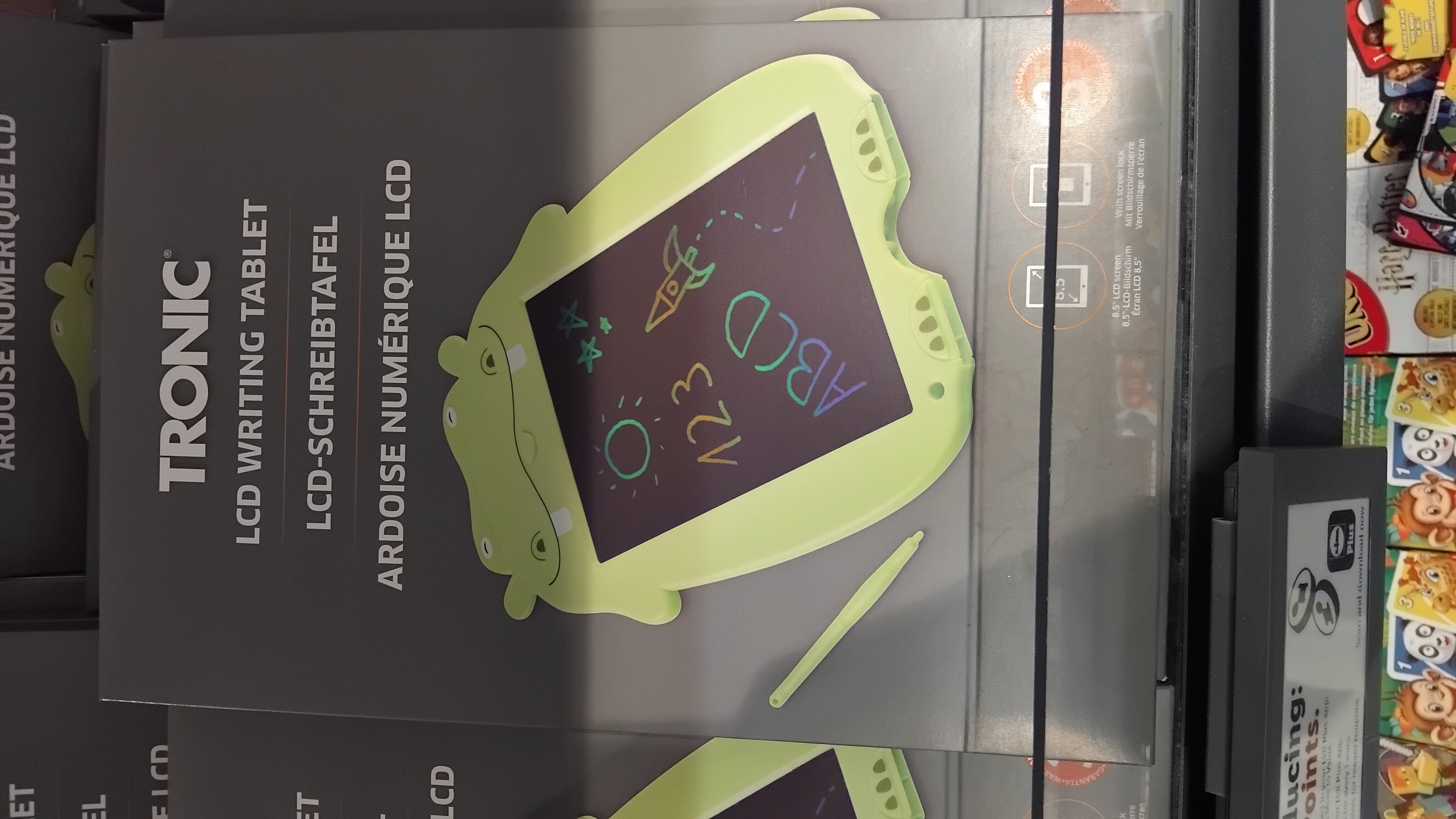
Lidl’s in-house electronics brand, TRONIC, has the audacity to market this piece of plastic as an "LCD Writing Tablet" (or "LCD-Schreibtafel"). Right in the middle of Europe, under the watchful eye of our supposedly strict consumer protection laws, they are loudly declaring this toy a digital display.
What is it in reality? It is a glorified piece of pressure-sensitive foil. You scratch it with a plastic stylus, and it reveals a static, multi-colored background underneath. It is an Etch-A-Sketch with a complex.
Premium Pricing for 90-Cent E-Waste
If you look at the back of the packaging in the next picture the illusion shatters completely. The grand "LCD screen" is powered by a single CR2032 coin battery, which is only used to send a tiny electrical pulse to clear the screen. There are no pixels. There is no active display. It is just a cheap, pressure-sensitive membrane.

If you go on Temu right now, you can buy this exact same base model, manufactured in the exact same Shenzhen mega-factories, for about 90 cents.
But at Lidl? You are paying a massive premium for the privilege of buying it in a cardboard box with a German brand name printed on it.
The Real Fear
This brings us to two inescapable conclusions about the modern retail landscape:
- The consumer apparently wants to be fooled. People will happily buy a cheap piece of scratch-plastic if you slap the letters "LCD" on the box and put it in a supermarket aisle, purely because the deceptive marketing makes it feel like a technological bargain.
- European retailers are not afraid of Temu. They do not care about e-waste, deceptive marketing, or hallucinated product features. They do this themselves every single day.
What the retail lobbies are actually terrified of is the realization that the consumer has figured out how to buy the garbage directly from the source. They don't want to stop the flow of falsely branded Chinese junk—they just want to ensure they remain the exclusive middlemen taking the markup.
They don't want to protect you from being scammed. They just want the monopoly on scamming you.